A Visit to Theodore Roosevelt National Park
“Life brings sorrows and joys alike. It is what a man does with them—not what they do to him—that is the true test of his mettle.” – Theodore Roosevelt
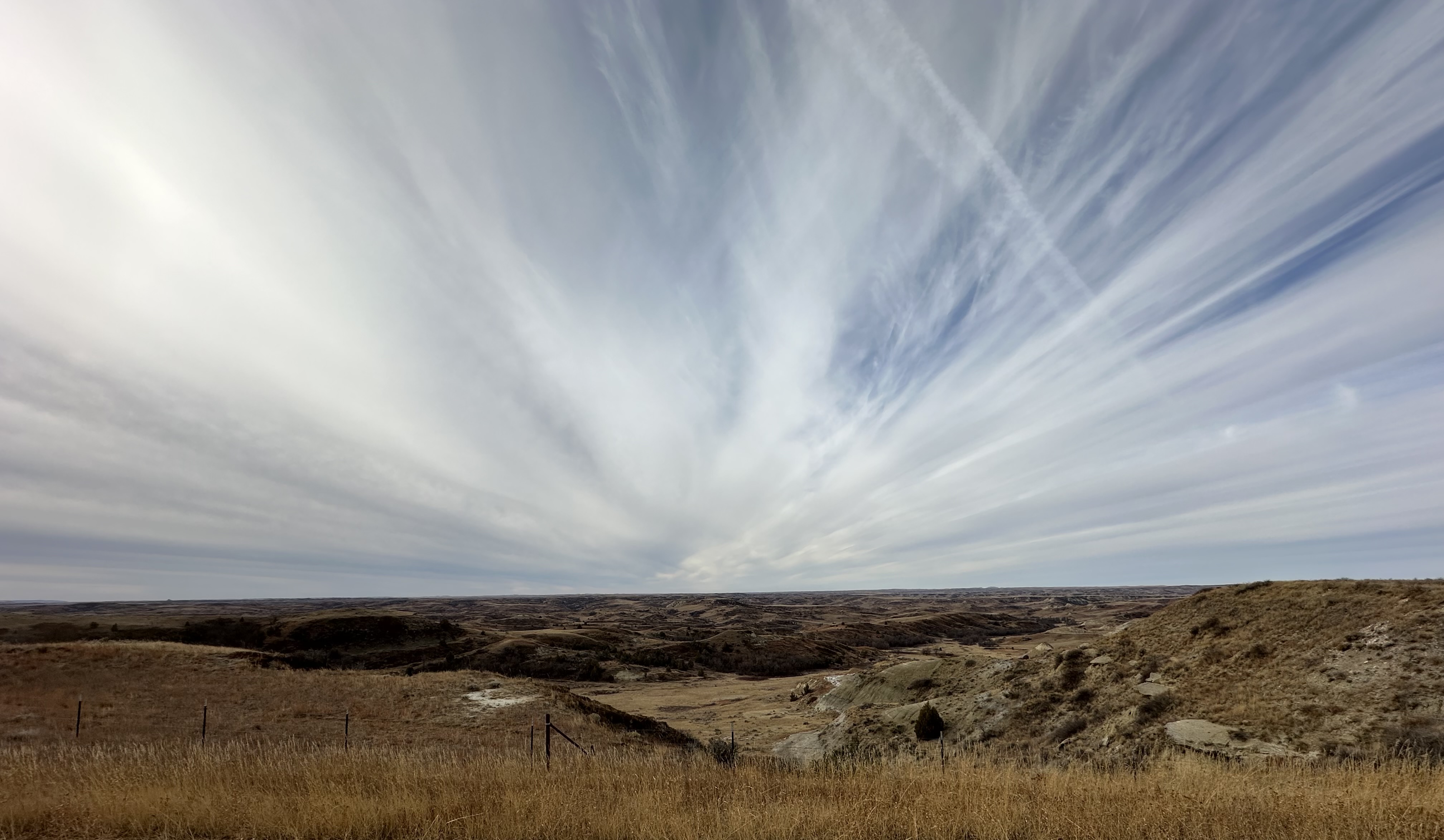
A Solitude That Speaks
Rarely does anyone think of North Dakota as a vacation destination. But I’m driving 600 miles to spend a long weekend in the North Dakota badlands. What drew me here was the chance to walk in the footsteps of a man I deeply admire but who has been dead for over a hundred years. These are the kinds of things I do; I know I am not normal.
I’m here to visit the site of Theodore Roosevelt’s ranch, to see the same country he saw, and experience for myself the place that had such a profound effect on him. And with any luck, I can get a dose of the healing he received from it.
Theodore (I won’t use the nickname “Teddy” out of respect for his loathing of it) came here for the first time to what was then the Dakota Territory in 1883. He was here to hunt buffalo, and in what ended up being a true to fashion Theodore-style epic adventure, he fell one of the few buffalo that were left in the area. The next year he returned, soon after the death of his wife and mother (they died on the same day) and after some setbacks with his political career. He was out of politics—permanently he thought. He had just lost everything. His life was in disarray. He needed a hard reset.
The year before, Roosevelt bought the Chimney Butte ranch near Medora, Dakota Territory, and upon his return in 1884 also purchased nearby land that he named the Elkhorn Ranch. The Elkhorn became his “home ranch”, the headquarters of his Dakota properties, and he built a new ranch house there.
The disastrous winter of 1886-87 practically wiped him out—and most of the other ranchers in the area. He never spent much time in Dakota after that. But TR found whatever he was looking for here in North Dakota. His career and life reinvigorated, he returned to his life in New York and in a few years became one of the popular presidents to have ever lived. He eventually sold his Chimney Butte and Elkhorn ranches. But his experience here remained with him for the rest of his life. “I would not have been President had it not been for my experience in North Dakota. It was here that the romance of my life began,” Theodore said later in life.
As the North Dakota hills roll by outside my truck window, I fantasize about my own desires to cowboy like Roosevelt did. I tell myself someday I’ll have some land and maybe a horse or two to ride. I don’t aspire to have cattle or run a ranch. I did at a younger phase in my life, but now I doubt it would be anything more than a hobby, and that’s an awfully back breaking and time-consuming hobby. When Theodore first came to North Dakota as a rich city-bred easterner, most folks here considered him a greenhorn pursuing ranching as a hobby. He quickly and thoroughly proved them wrong. He took ranching and his properties seriously. He became very active in the local community and started the area’s stockmen’s association.
In 1947, Congress created what was then called Theodore Roosevelt National Memorial Park, consisting of scenic badlands terrain in proximity to Roosevelt’s ranch. It had two separate units—a south unit just outside of Medora, North Dakota, and the north unit near Watford City. The Elkhorn headquarters was added as a separate third unit in 2012. It is located between the other two units and is a scenic drive on remote dirt roads about half an hour or so from Medora. Over the years, Medora has become the world headquarters for all things Theodore Roosevelt. The tiny speck on the map (2020 population was a whopping 121) is almost entirely dedicated to the former president. It has more restaurants and shops than a town its size should have, and practically all of them are TR-themed. It is home to the offices and visitors center for the National Park, the Medora Musical (a summer production about TR’s life, held in a 3000 seat amphitheater on the outskirts of town), and coming in 2026, the Theodore Roosevelt Presidential Library. To accommodate all this tourist activity, its hotel rooms outnumber residents almost five to one. This town, like TR, punches above its weight class.

True to my nature as a tightwad, I had booked a room at the cheapest motel I could find—an AmericInn on the south side of town. But because it caters to tourists, there is not a bad or seedy place to stay in Medora. I arrive late this November afternoon, so the sun is already below the horizon. It is the next morning in the light of day that I can first appreciate Medora’s picturesque setting. Surrounded by low but steep hills on all sides, it feels like a mountain town got lost and wandered into North Dakota. The Little Missouri River snakes its way just west of town, and the straight-as-an-arrow tracks of the old Northern Pacific (now the BNSF railway) cut right through the middle. It was on these tracks that Roosevelt visited the town by train in 1903 and in Roosevelt’s words “the entire population of the badlands down to the smallest baby had gathered to meet me. They all felt I was their man, their old friend, and even if they had been hostile to me in the old days when we were divided by the sinister bickering…of all frontier communities, they now firmly believed they had always been my staunch friends and admirers. I shook hands with them all and I only regretted that I could not spend three hours with them.” Being just a few blocks wide as it is long, the entire town is walkable from almost any motel or hotel, and as I mentioned there are quite a few souvenir shops to browse and restaurants to sample. But I’m not here for Medora.
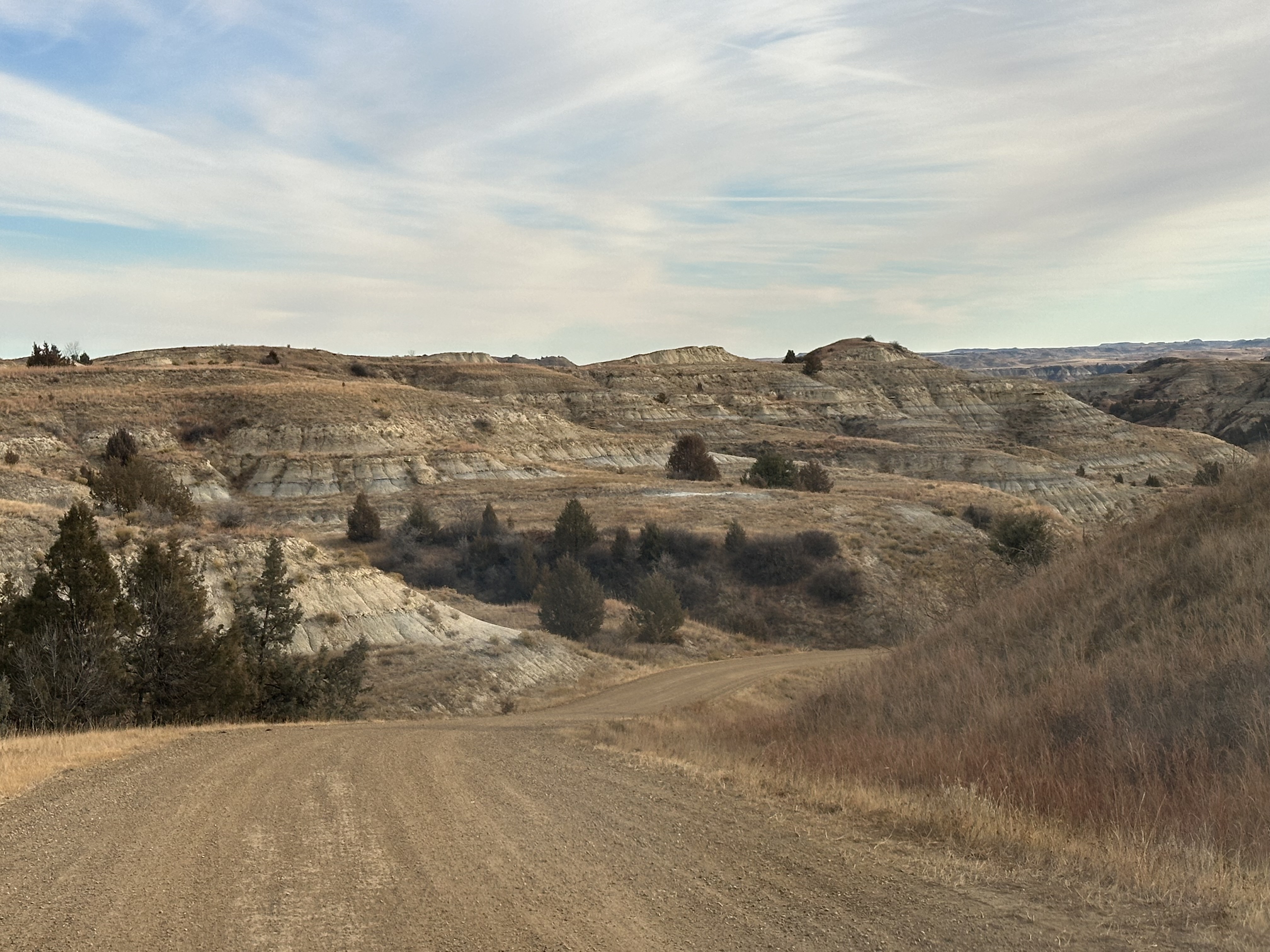
My very first stop on this morning of my first day is the site of the Elkhorn ranch. I head west on the highway out of Medora for a few miles before turning north on a country road and immediately find myself at the edge of the Earth. It is beautiful country. Rolling desolate hills. Skies bigger than creation itself. And not a damn person for miles. The isolation is overwhelming. Thankfully, I have directions to the Elkhorn—you will not get there without them. There is no cell service and there are no signs. I turn here and I turn there and feel like I’m traveling in circles. Eventually, the road drops into a narrow draw, then after a few miles empties out into a wide river plain and an empty gravel parking lot with a large wooden sign at one end, the words “Elkhorn Ranch Unit” at the top. I walk a rough dirt path that aimlessly weaves its way through tall grasses and scrub timber until I arrive at a metal gate and a fenced in area about an acre square. I open the gate and explore the area. Just foundation stones remain of Theodore’s ranch house and faint traces of some outbuildings. The river has moved a quarter mile west, but in TR’s day, the banks had been just a literal stone’s throw from his ranch house.
The crisp November air holds the faint but constant rumble and whir of an oil or gas well in the distance. I chuckle. I don’t think TR would have appreciated that.
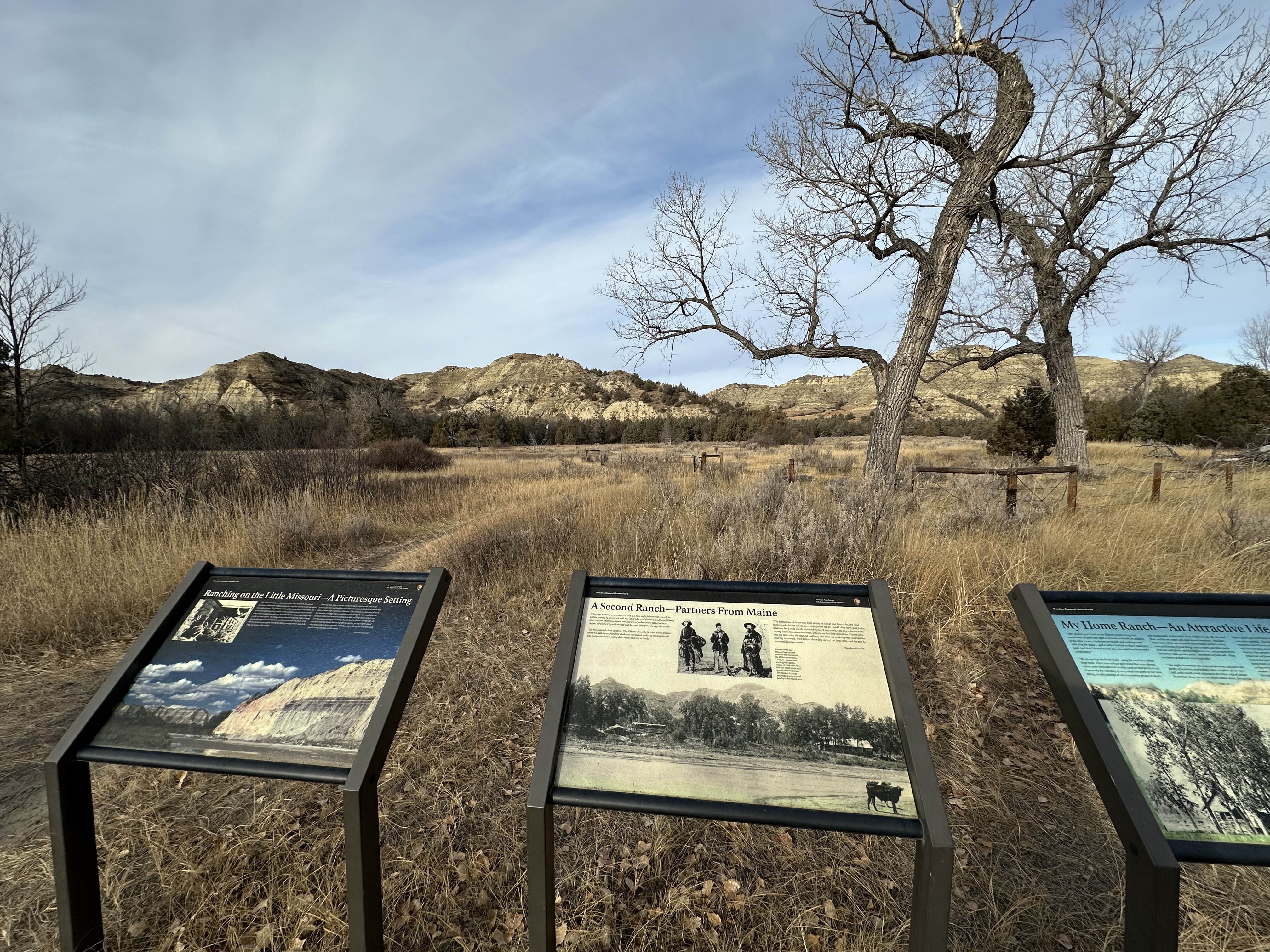
I sit on a foundation stone and contemplate TR’s life, wondering why he resonates so much with me. It was here in this exact spot that he wrote two of his early books. He sat on the porch in a rocking chair in the cool evening breeze, and in the silence looked out over the river and reflected on his life and its tragedies, his past political setbacks, his disdain for the greed and power politics of his day, and the damage humanity was inflicting on the world’s great natural wonders.
Just as much as we would agree on topics like conservation and corporate power, we would have vigorous debates on other policies, including immigration. Many of his policies walked a worrisome line with nationalism. But I can identify with his imperfections. We both have worts. He was a man of his time and a reflection of his era. I admire him for what we can agree on and I appreciate him for our differences.
We are both writers, intellectuals, and outdoorsmen. I think as much as he loved nature, he loathed greed. In that lies our greatest connection. We seem to have the same view on how wealth and power corrupts. In his society as much as ours today, greed was a driving motivation for politicians. But in our time, greed is pervading all corners of society to such an extent that it’s killing such things as honor, civility, character, and decency. Our voting trends tend to indicate we are willing to sacrifice almost everything for a good economy and a few bucks in our wallet—common sense and decency be damned.
TR’s advice to “speak softly and carry a big stick” would be confounding to many leaders today, who prefer to incoherently brag and boast or spew unbridled emotional resentment to rile up their base. Roosevelt showed us that restraint is not the absence of power, but the refusal to weaponize it. I’m afraid such subtle cognitive paradoxes are beyond comprehension for today’s point and click society.
I’ve had the ranch site to myself for over an hour. I’m rarely afforded the kind of luck that allows me an entire uninterrupted hour in a place that holds this much meaning to me. I am grateful. I stand up from the cold foundation stone and the heavy metal gate groans as I swing it aside. I leave the area with a heavy heart. I don’t think TR would be particularly proud of who we are today and how we’ve carried the torch. Climate change deniers and fossil fuel interests threaten his conservation legacy. His “strenuous life” philosophy has been poisoned by toxic masculinity and corrupted by wimps hiding behind tough guy facades. His intellectualism has been sidelined by anti-science, anti-reason, and anti-common sense conspiracy theorists. Celebrity billionaires flood our social media with disinformation and our politics with money, all while trying to convince the public they’re one of us. Our admiration of them shows a total lack of common sense that billionaires have only their own best interests in mind.
We needed TR then, but we need him more now.
My generation grew up being told government is the problem. Theodore would have challenged that narrative. While acknowledging government’s disfunction and inefficiency, he would have suggested that perhaps billionaires and corporate interests are more sinister issues. I’ll spare you a complete history lesson, but America today closely resembles the America of TR’s time. The “guilded age,” as it was known, was defined by unprecedented wealth disparity amongst economic classes. A growing populist movement exploded in labor strife, riots, and general unrest throughout the 1890s. When Roosevelt became President, he immediately went to work dismantling monopolies and limiting the unbridled power of the wealthy elite. Though he came from a wealthy family, he understood that unchecked power of a wealthy elite undermines democracy.
But the populist movement of today bears little resemblance to its 19th century counterpart. Elon Musk and other celebrity billionaires have hijacked populism and somehow convinced working and middle class folks that billionaires have all the solutions to our country’s problems. The best con men convince you they can relate to you, even if it’s obvious they can’t. They promise us that prosperity will magically “trickle down,” though the data shows us it rarely does. TR would have known better. We all should know better. But politicians have misrepresented working and middle class Americans for so long that they can’t trust anyone from inside the Beltway. It is so bad, Americans will blindly place their faith in anyone they perceive as an outsider, even if facts and common sense continue to indicate the outsiders are even more corrupt than the insiders they were so eager to vote out.
I pass one guy walking in on my way back to my truck. There’s a sprinter van from New Hampshire parked in the lot. I thought I’ve come a long way. I hope he’s here for the same reason I am, and I hope he finds what he’s looking for.
The Wind Carries Memories
I get back on the dusty North Dakota backgrounds and head for the national park’s North Unit, carefully following directions to state highway 16. This road flirts with the Montana border on its meandering path north, then I pick up US85 east towards Watford City, then turn back south. This country is vast and roadless. Though the Elkhorn and North Units are separated by twenty or thirty miles as the crow flies, it’s almost a 100 mile circuitous drive. But it’s worth it.
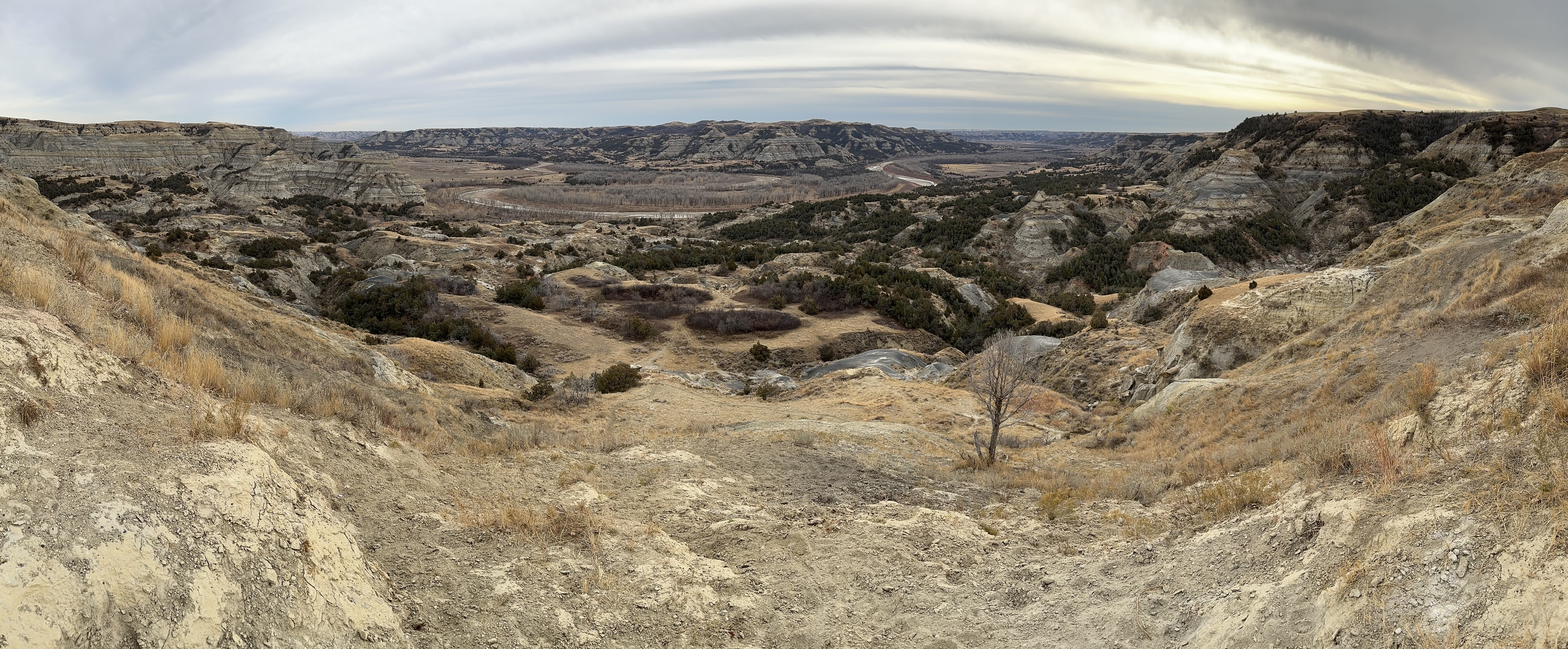
The North Unit has a reputation for being wild and undeveloped—a reputation that it has earned. There is one paved road, an out and back that snakes its way through the Little Missouri River bottoms before climbing on top of the hills containing the river to the north. The roadside overlooks of the Little Missouri and the surrounding badlands leave me breathless. The late afternoon sun is hiding behind thin clouds, casting a satisfying flat light on the landscape. Hiking trails abound from roadside stops, including one that becomes my favorite and leads to a stone overlook shelter built by the NPS. This overlook provides a sweeping, seemingly limitless view of the river valley and badlands. It is almost certain Theodore explored this area on horseback during his years here. It is becoming increasingly clear to me why this place forged such an impression on him.

It’s dark before I make it back to Medora and grab a bite at a local bar. After dinner I take a quick walk around the dark town. Besides myself, a few deer are hanging out on Medora’s streets tonight. It’s a far different atmosphere from summer when the place is teeming with tourists and restaurant crowds spill out onto the streets until late at night.
The next morning I wake up to a bitter cold wind and a skiff of snow. It is downright uncomfortable outside, and I find it ironically fitting. Theodore popularized (if not invented) the concept of purposefully seeking discomfort. He called it the “strenuous life,” and my adventure through the park’s South Unit today is going to be particularly strenuous in the 20-30 mile an hour winds and stinging sleet. Theodore wouldn’t have cared; hell, he might have even loved it. I’d tell him I’m really trying, but my warm truck is still a nice respite.
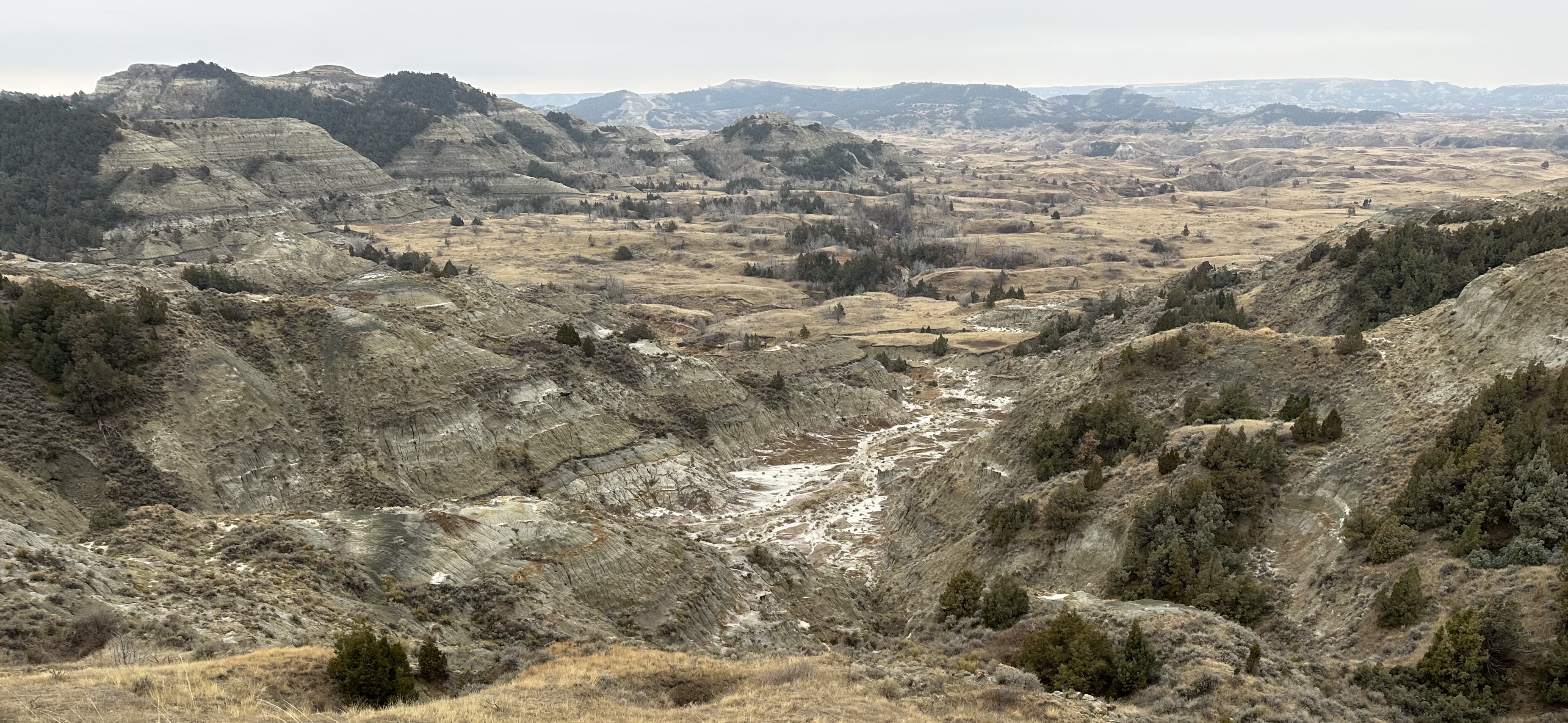
The South Unit has a paved loop road that plunges into the badlands north of Medora. Though it lacks the dramatic vistas of the North Unit, the South does offer numerous hiking trails, buffalo, and a herd of wild horses that I’m lucky enough to see. I stop at the Wind Canyon trailhead and hike down a fun draw to the Little Missouri, where I watch an Eagle hunt for lunch. I imagine scenes like this must have been normal, if not mundane, for Roosevelt. But for me, in November 2024, watching our national symbol soar through the air above a leisurely river flowing through badlands in the absolute middle of nowhere is quite a noteworthy treat. And just like Theodore would have preferred, it’s not even 30 degrees and I’m getting pelted with sleet.

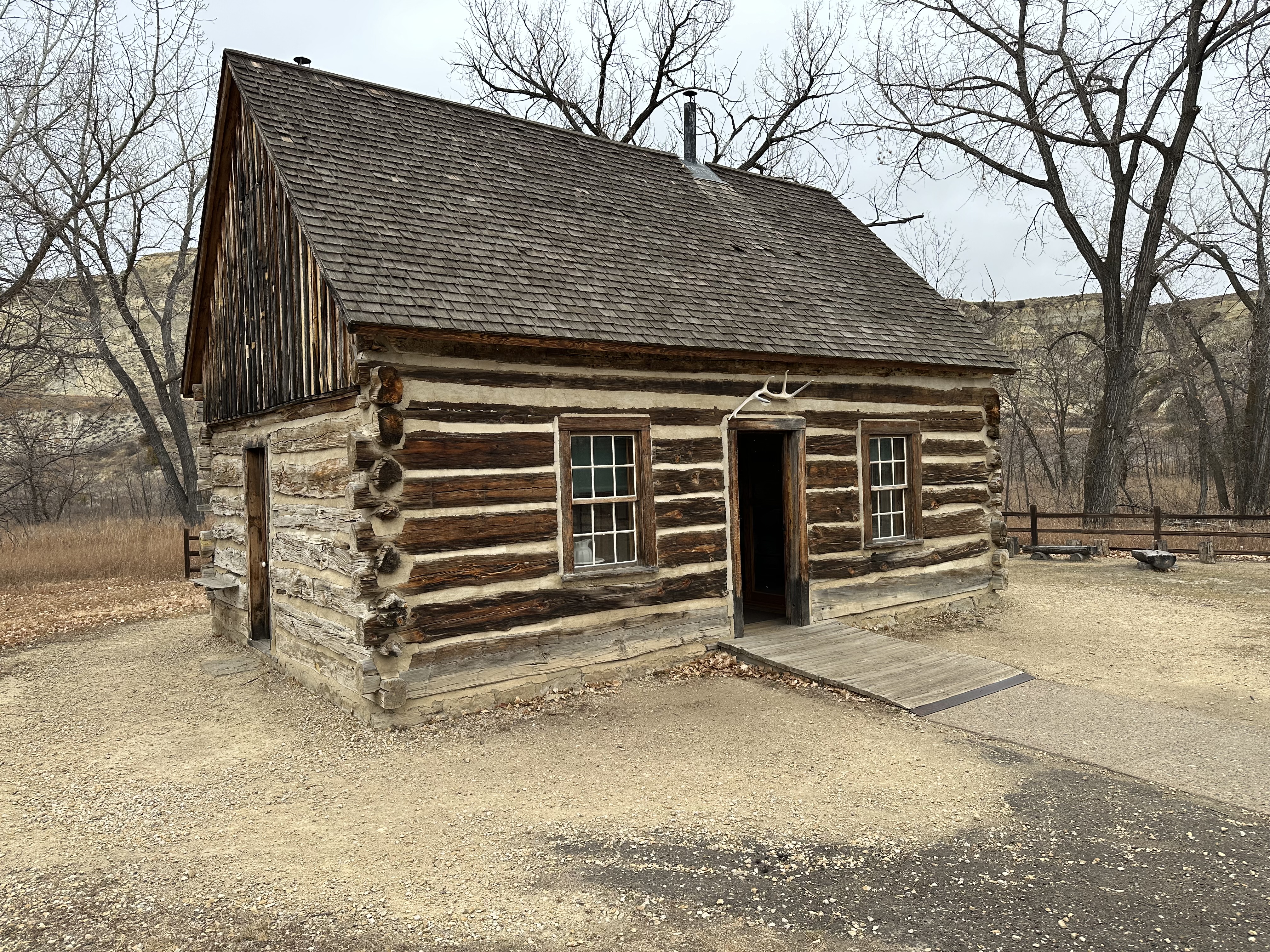
On my way out of the park I stop at the visitor’s center. It’s small but jam packed with displays on Roosevelt’s life, including some artifacts that I’m surprised they have, like the undershirt he was wearing during an unsuccessful assassination attempt in 1912. The bullet hole is plainly visible in the shirt, just below the heart. Something I have been most looking forward to is seeing the Chimney Butte ranch cabin, which sits behind the visitor’s center. This is the actual cabin from the Chimney Butte, Theodore’s original ND ranch, restored and moved to the visitor center grounds after the national park was established. It includes original furnishings, including Theodore’s writing desk—which I geek out on immediately when I step through the cabin door. Glass separates the visitor from the furnishings, but still, this is the very building where Theodore spent his time when he first came to North Dakota. I can just stand and stare as long as I want—I have the cabin to myself. I saw only a few other crazy people in the entire park this bitterly cold day. The entire weekend has turned into a private tour of a national park and of the life of the man it’s named after.
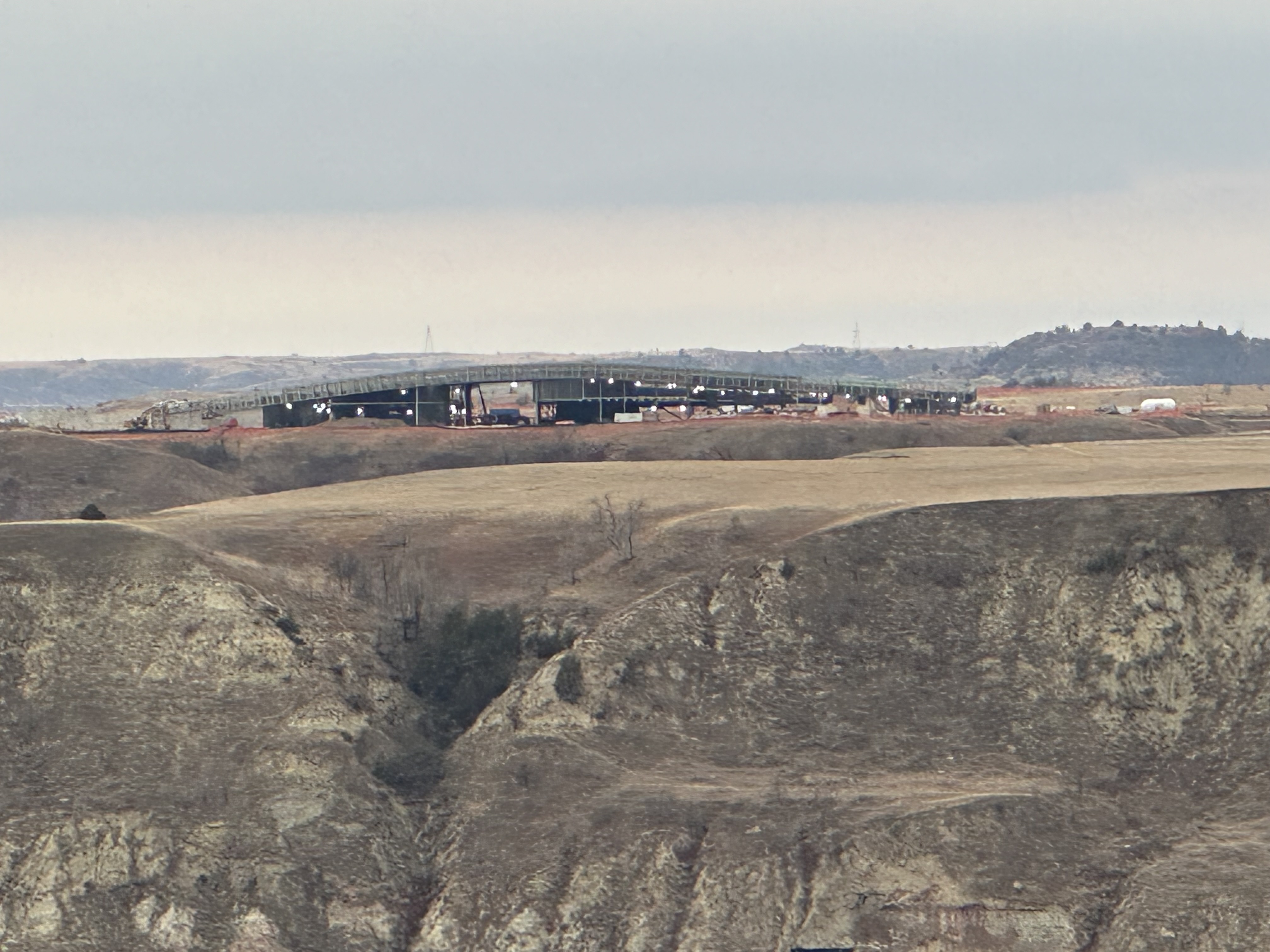
After I leave the visitor center, I walk the streets of Medora in daylight and find a life size bronze statue of Theodore on one street corner. I take a selfie. Then I grab dinner at another local bar. My weekend is winding down and it is bittersweet. But I will be back. A massive presidential library is being built on a plateau just west of Medora. It’s opening on July 4, 2026, and I plan to be one of the first to walk through its doors.
The Land That Rebuilt a Man
As I sip a beer at the Little Missouri Salon & Dining Room and reflect on my trip, I cannot stop thinking about how much the Elkhorn was a spiritual experience for me. I understand why this place appealed to him so much and why it healed him. There is a stark beauty in these badlands that even a writer will struggle to describe. In Theodore’s time, this place was about as remote as you could find. I think he was an introvert like me. I spent most of my time on this trip alone, hours in the backcountry without seeing signs of another human. I am tempted to describe Theodore Roosevelt National Park as empty. Yet it was crowded with significance and sentiment. Nothing is here except everything that matters. These things you can’t see or touch but you can feel them, much like healing. You’re not supposed to take anything from a National Park, but I hope the NPS doesn’t mind if I bring a little bit of that home with me.
Theodore Roosevelt National Park gives us some insight into one of the nation’s greatest presidents and citizens. It’s the only national park that’s named after a person and now I know why. This park isn’t here just to show off pretty landscapes and awe-inspiring vistas. It’s here to reinforce the idea that as a human being, each of us has an indelible bond to the Earth. This is the place that healed Roosevelt. It’s where he rediscovered life after some of his most precious people had been taken from him. It’s where he found meaning in suffering and a reason to go on. We all need a place like that. I hope I find mine, and if you haven’t found yours, I hope you discover it soon.


 Steve Grimes
Will you be writing a book anytime soon? Loved learning some things about a subject and man I’d not really given much thought to (tsk tsk, I know). Wh
LikeLiked by 1 person
A book about TR specifically? I have never considered it. Maybe I should…
But I do have a few book projects in various stages of development. There won’t be anything out in the near future, but I think that will change in the next 3-5 years.
LikeLike
No, not about him specifically. Just a book, any subject! Does that narrow it down? Ha!
LikeLike